

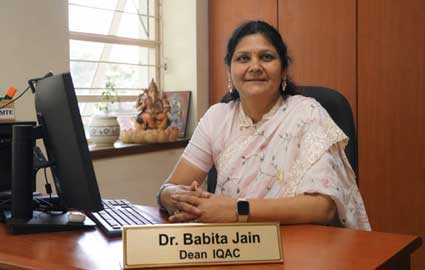
Greetings to our institutional stakeholders, including students, parents, faculty members, employers, alumni and representatives of academic and statutory bodies.
Quality at NHCE is a sustained institutional commitment. In line with NAAC quality-assurance principles and Outcome-Based Education, IQAC works to make quality practices part of routine academic and administrative functioning.
We focus on well-defined, consistent and evidence-based processes across teaching and learning, student progression, employability and governance. Regular review and meaningful institutional data help align these systems with long-term academic improvement.
IQAC strengthens structured teaching-learning practices, stakeholder feedback and its analysis, academic and administrative reviews, internal audits, student mentoring and support, and reliable digital documentation. These systems are intended to improve transparency and preparedness for quality assessments.
Working with academic departments and institutional stakeholders, IQAC facilitates shared responsibility for the continuous improvement of institutional processes and academic excellence.
Dr. Babita Jain
Professor & Dean IQAC
New Horizon Educational Institution
Vision & Mission
Vision
To institutionalize a sustainable culture of quality, excellence, innovation, and continuous improvement through robust, process-driven, and data-informed systems aligned with the institution’s commitment towards academic excellence, industry relevance, ethical values, societal contribution, and global competitiveness.
Mission
- Establish transparent, system-driven academic and administrative processes ensuring consistency, effectiveness, and institutional alignment.
- Promote Outcome-Based Education, innovation, research, experiential learning, and industry interaction to enhance quality and employability.
- Strengthen data-driven governance through robust documentation, analytics, audits, compliance systems, and accreditation readiness.
- Facilitate Continuous Quality Improvement through ethical, inclusive, and outcome-oriented quality practices and monitoring systems.
Quality Policy & Goals
Quality Policy
Quality is a continuous, system-driven institutional responsibility aimed at achieving academic excellence, stakeholder satisfaction, innovation, and societal impact.
Goals
- Develop a fully integrated institutional quality management system.
- Ensure audit-ready documentation, evidence mapping, and standardized institutional practices.
- Strengthen NBA, NAAC, NIRF, ranking, and quality benchmarking readiness.
- Implement centralized digital documentation, analytics, and workflow systems.
- Enhance teaching-learning effectiveness, experiential learning, employability, and student outcomes.
- Foster a culture of accountability, innovation, transparency, and continuous improvement.
- Strengthen institutional systems that support ethical values, professional competence, and stakeholder satisfaction.
Four Quality Initiatives
Institutional mechanisms for systematic review, informed action and measurable improvement.
Semester-start and semester-end internal audits, followed by annual external review.
Two-observer assessment, corrective actions and re-observation through Contineo.
Stakeholder feedback collection, analysis, action taken and improvement monitoring.
Mentor–mentee support, digital records, escalation and closed-loop follow-up.
Explore IQAC Resources
Detailed information and approved institutional records remain available through the tabs above and these quick links.
Operational areas and responsibilities
Current committee and year-wise membership
Original organogram and responsibility mapping
Academic Year 2026–27 directory
Annual quality assurance records
Published meeting records and archives
dean.iqac.nhei@newhorizonindia.edu
Four Quality Initiatives
Four institution-wide frameworks connect academic review, classroom practice, stakeholder feedback and student mentoring with evidence-based quality improvement.
Academic Audit
Four internal reviews and an annual external audit.
View framework and procedure →Class Observation
Dual-observer evaluation and faculty improvement actions.
View framework and procedure →Feedback Management
Stakeholder inputs, analysis, ATR and monitoring.
View framework and procedure →Mentoring Quality Assurance
Structured mentoring, ERP tracking and issue closure.
View framework and procedure →Annual Audit Cycle
IQAC conducts a structured academic audit cycle covering both the odd and even semesters. Each semester includes a semester-start internal audit and a semester-end internal audit. On completion of these four internal audits, an external academic audit reviews the academic year as a whole.
Semester-Start Internal Audit
After classes commence, IQAC initiates the semester-start audit approximately two weeks into the semester, generally in weeks three to four. The audit verifies 31 initial operational and academic readiness items needed for smooth departmental functioning across both odd and even semesters.
Physical Verification During the Semester
During semester delivery, the audit process includes physical verification of white attendance registers, academic records and classroom and laboratory compliance to confirm whether prescribed processes are being followed in practice.
Semester-End Internal Audit
At the close of each semester, IQAC verifies a set of 72 departmental files aligned with NBA, NAAC and institutional requirements. Audits check the completeness, organisation and evidentiary quality of departmental records.
External Academic Audit
After four internal audits have been completed across the academic year, an external academic audit is undertaken. External experts undertake a comprehensive review of the 72-file framework, internal observations and Action Taken Reports.
Expected Audit Outputs
- Compliance status and observation reports
- Non-conformities, deficiencies and identified gaps
- Corrective actions and Audit Action Taken Reports (ATR)
- Inputs for continuous quality improvement
View Framework Infographic • Official IQAC Process Framework
Class Observation System
The class observation framework is designed to strengthen the teaching-learning process through systematic, non-intrusive classroom observation, two-observer assessment, structured feedback and evidence-based follow-up. The supplied 2026-27 infographic describes a proposed framework for implementation.
Observation Cycle
Two class-observation cycles are specified for each semester. The first cycle commences from the third week. The second cycle, described as re-observation, is conducted approximately three weeks after the Class Observation Suggestive Action Report is issued.
Two-Observer Model
Observer 1: Institutional quality perspective (Dean-IQAC or Associate Head - IQAC).
Observer 2: Academic perspective (concerned HoD, senior faculty member, or subject expert nominated by the HoD).
Mode of Classroom Observation
Preferably, observers attend one complete theory period lasting approximately 30-45 minutes. Observation is to be non-intrusive and should not be pre-scheduled or intimated in advance, so that routine teaching practice is reflected.
Re-Observation and Digital Reporting
Provides for re-observation during the same semester when the average score of the two observers is 3.50 or below, or when the score given by either observer is 3.50 or below. Contineo provides faculty-wise and department-wise reporting.
Assessment Rubric: 10 Evaluation Metrics
| Category | Evaluation Parameter | Weightage (Observer 1 / Observer 2) |
|---|---|---|
| Academic Evaluation (Five Metrics) | 1. Subject knowledge and conceptual clarity | Observer 1: 0.3 Observer 2: 0.7 |
| 2. Use of examples and practical applications | ||
| 3. Teaching progression and sequencing | ||
| 4. Interaction and concept verification | ||
| 5. Topic coverage and closure | ||
| IQAC & Pedagogical Evaluation (Five Metrics) | 6. Planning and preparedness | Observer 1: 0.7 Observer 2: 0.3 |
| 7. Communication, content delivery and professionalism | ||
| 8. Teaching methodology and pedagogy | ||
| 9. Student engagement and classroom management | ||
| 10. Use of teaching aids and ICT tools |
View Framework Infographic • Official IQAC Process Framework
Feedback Management
The proposed feedback framework creates a systematic mechanism for collecting stakeholder input, analysing responses, communicating findings, undertaking corrective actions and monitoring improvement through a closed-loop process.
Teaching-Learning Assessment Process (TLAP)
TLAP feedback (Question Set QS1) is collected twice per semester: the first phase after CIE-I and the second phase after CIE-II. 15 questions cover planning, concept clarity, pedagogy, and CO-PO linkage.
Course Exit Survey (CES)
Arranged by the course coordinator and collected once per semester after CIE-II to measure individual course attainment.
Institutional Facilities & Student Support
Institutional feedback (QS2 & QS2a) is collected once per semester after CIE-II for final-year students. QS2 covers academic and campus support; QS2a covers placement and training.
Graduate Exit Survey
The Graduate Exit Survey (QS3) is collected once per graduating batch on graduation day. 12 questions address engineering knowledge, design, communication, ethics, and attributes.
Faculty, Alumni and Employer Feedback Schedules
- QS4 – Faculty Institutional Support Feedback: 10 questions scheduled annually in June.
- QS5 – Alumni Feedback: 12 questions scheduled annually in March.
- QS6 – Employer Feedback: 12 questions scheduled annually in March.
View Framework Infographic • Official IQAC Process Framework
Digital Mentoring Ecosystem
The mentoring ecosystem establishes clear reporting, faculty engagement, student support, issue escalation, ERP documentation, department review and institutional closure. It is intended to be structured, digital, data-informed and closed-loop.
Institutional Mentoring Committee
The Principal chairs the committee, supported by the Vice Principal (Academics), Dean-IQAC, Associate Head-IQAC, Departmental Mentoring Coordinators and HoDs, meeting monthly to review cases and trends.
Faculty Mentoring Frequency
One dedicated mentoring hour weekly, plus at least three defined interactions around CIE: two weeks before CIE-1, two weeks after CIE-1 and two weeks before CIE-2.
Contineo ERP Workflow
Faculty mentors log session date, student details, issues, advice, severity, and escalation needs. Students and parents view and acknowledge records through their respective portals.
Escalation & Issue Closure
Escalation sequence: Faculty Mentor → Departmental Mentoring Coordinator → Associate Head-IQAC → Concerned Office/HoD → Action Taken → Closure in ERP.
Issue Classification and Routing
| Category | Addressed Matters | Responsible Routing Office |
|---|---|---|
| Academic Matters | Attendance shortage, CIE performance, backlogs, slow learners | HoD / Course Coordinator |
| Placement & Careers | Internships, placement preparation, certifications, higher studies | Career Development Center (CDC) |
| Personal / Emotional | Stress, motivation, emotional and adjustment issues | Counsellor / Student Welfare |
| Administrative / Campus | Hostel, accounts/fees, discipline, medical, maintenance | Registrar / Accounts / Medical Officer / Maintenance |
View Framework Infographic • Official IQAC Process Framework
Affiliation / Accreditation / Ranking
The consolidated institutional accreditation, affiliation and ranking information is maintained by the college.
Select the link below to open its official institutional page.
Affiliation • Accreditation • Ranking
NAAC/NBA
Annual NAAC quality reports and the institutional strategic roadmap are presented here as structured on-page content.
EXPLORE THE SECTIONAQAR
Open the AQAR originally submitted and published by the institution.
Annual Quality Assurance Report (AQAR)
Annual Quality Assurance Report (AQAR)
Annual Quality Assurance Report (AQAR)
Annual Quality Assurance Report (AQAR)
Strategic Plan
NHCE Institutional Strategic Plan 2026-2031. The published strategic-plan PDF can be opened directly below.
Published institutional planning document.
Eleven strategic pillars (2026-2031)
Selected 2031 institutional targets
| Measure | 2026-2031 target |
|---|---|
| NIRF ranking | Top 150 |
| NAAC grade | A++ |
| NBA | Majority of eligible programmes accredited |
| Scopus-indexed publications | 800+ |
| Patents filed | 200+ |
| Research funding | ₹15-20 crore cumulative |
| Placement rate | 95% |
| Start-ups incubated | 50+ |
| International collaborations | 25+ |
| Smart classrooms | 100% |
| Digital governance | Fully integrated |
DIGITAL GOVERNANCE
Standard operating procedures, documentation, data systems and evidence mapping provide the basis for digital quality governance.
EXPLORE THE SECTIONDigital Documentation
Digital records and standardized institutional processes are explicit priorities of NHCE IQAC and the 2026-2031 strategic plan.
- Apply approved naming, indexing, document-control and revision conventions.
- Preserve version history and the ownership of source records.
- Use consistent evidence and reporting structures for audit and accreditation needs.
- Restrict access to personnel, student, assessment and other confidential records.
Digital Repository
The digital repository is the institutional organising framework for approved standard operating procedures, templates, manuals, policies and supporting evidence. No comprehensive downloadable repository was reproduced on the public IQAC webpage.
- The repository framework categorises SOPs, Templates, Manuals and Policies.
- Documentation controls support file ownership, versions, issue dates and periodic review.
- An approved file-by-file repository catalogue is not provided on the old public IQAC page.
SOP
This digital-repository category is designed to publish process flows and responsibilities across approved institutional functions. It follows the documentation standardisation objective described on the NHCE IQAC site.
- Use the latest authorized version of each document.
- Display its title, approved date, revision number and responsible unit.
- Archive superseded versions rather than silently overwriting them.
Templates
This digital-repository category is designed to publish current approved formats, checklists and forms. It follows the documentation standardisation objective described on the NHCE IQAC site.
- Use the latest authorized version of each document.
- Display its title, approved date, revision number and responsible unit.
- Archive superseded versions rather than silently overwriting them.
Manuals
This digital-repository category is designed to publish official user guides and operating instructions for academic or quality systems. It follows the documentation standardisation objective described on the NHCE IQAC site.
- Use the latest authorized version of each document.
- Display its title, approved date, revision number and responsible unit.
- Archive superseded versions rather than silently overwriting them.
Policies
This digital-repository category is designed to publish formally approved institutional rules and quality policies. It follows the documentation standardisation objective described on the NHCE IQAC site.
- Use the latest authorized version of each document.
- Display its title, approved date, revision number and responsible unit.
- Archive superseded versions rather than silently overwriting them.
Best Practices
Explore the quality-assurance practices and improvement mechanisms described in NHCE's institutional reports.
EXPLORE THE SECTIONInstitutional Best Practices
The NHCE 2023-24 AQAR documents two institutional quality practices: internal audit based on the Plan-Do-Check-Act (PDCA) cycle and activities of the Quality Assessment and Skill Development Center.
- Internal audit using PDCA: planned academic work is implemented, audited and improved using evidence from course files, OBE reports and review processes.
- Quality Assessment and Skill Development Center: capacity-building activities aimed at strengthening institutional staff and faculty capabilities.
- These examples reflect the 2023-24 AQAR and should not be presented as a verified new 2026 ranking or award.
Department Quality Initiatives
IQAC works with academic departments to integrate quality processes, review evidence and encourage innovation in academic practice.
- Recommended department-wise entries: title of practice, problem addressed, method, measurable outcome, photos or evidence, responsible department and academic year.
- Capture learning improvements, industry involvement, experiential activities, mentoring and effective documentation processes where evidenced.
- Use approved, verifiable outcomes; do not present proposed activities as completed achievements.
IQAC MOM & Reports
Meeting records, audit practices, annual reporting, feedback analysis, class observation and action-taken mechanisms.
EXPLORE THE SECTIONIQAC Committee MOM
Year-wise original IQAC meeting minutes, available as published PDFs.
Audit Reports
One academic year contains four internal audit checkpoints (semester start and semester end for both semesters), followed by one comprehensive external academic audit. Report locations below are organised accordingly.
2026-27
Approved PDF to be uploaded
Approved PDF to be uploaded
Approved PDF to be uploaded
Approved PDF to be uploaded
Approved PDF to be uploaded
Approved PDF to be uploaded
Approved PDF to be uploaded
IQAC Annual Reports
The IQAC Annual Report archive is arranged by academic year. Upload approved consolidated annual report PDFs when released.
2026-27
Approved PDF to be uploaded
Feedback Reports
Consolidated stakeholder feedback reports are filed semester-wise. The corresponding action-taken record is maintained in the same academic-year folder.
2026-27
Approved PDF to be uploaded
Approved PDF to be uploaded
Approved PDF to be uploaded
Approved PDF to be uploaded
Class Observation Reports
Class observation records are organised by academic year, semester parity and class semester. Each report may be accompanied by its relevant Action Taken Report.
2026-27 • Odd & Even Semesters
Approved PDF to be uploaded
Approved PDF to be uploaded
Approved PDF to be uploaded
Approved PDF to be uploaded
Approved PDF to be uploaded
Approved PDF to be uploaded
Approved PDF to be uploaded
Approved PDF to be uploaded
IQAC Events
Documented academic-development and quality-building programmes from the institutional archive.
EXPLORE THE SECTIONFDPs
The NHCE quality and skill-development archive includes faculty programmes supporting OBE and technical capability-building. The examples below are historical published activities, not claims about current-year delivery.
- Outcome-Based Education and Outcome-Based Accreditation session, October 2022.
- Digital System Design Using Intel FPGAs faculty programme, September 2022.
- Additional faculty development and induction events are listed in the historical quality development archive.
Published event directory
| Year | Programme / event listed in the NHCE quality-development archive |
|---|---|
| 2022 | Outcome-Based Education Framework and Outcome-Based Accreditation |
| 2022 | Digital System Design Using Intel FPGAs |
| 2022 | Domain-based programme on Statistical Package for Social Science |
| 2022 | Faculty induction programmes (even and odd semesters) |
| 2022 | SMARTBOARD++ faculty training |
Workshops
The official quality and skill-development archive lists workshops and practical learning activities intended to build teaching and professional capability.
- Design Thinking workshop (published archive entry).
- Workshop on metacognitive teaching-learning using ICT tools (listed in the 2022 event archive).
- Select programme reports by year and include date, organizer, audience and documented outcomes.
Published event directory
| Year | Programme / event listed in the NHCE quality-development archive |
|---|---|
| 2023 | Design Thinking Workshop |
| 2022 | Metacognitive Teaching-Learning Process Using ICT Tools |
| 2022 | Hands-on Session on Research Writing |
| 2022 | Development of FPGA-Based AI Product Design Techniques – industry interaction |
Seminars
Seminars and institutional sensitisation activities support knowledge exchange, wellbeing, compliance and continuous professional improvement.
- Digital Automation of Accreditation seminar held 18 August 2022.
- Seminar on navigating adolescence and young adulthood appears in the quality centre archive.
- Archive later events by academic year and include signed/approved reports.
Published event directory
| Year | Programme / event listed in the NHCE quality-development archive |
|---|---|
| 2023 | Navigating through Adolescence and Young Adulthood |
| 2022 | Digital Automation of Accreditation |
| 2022 | Research Writing lecture series |
| 2022 | International Webinar on Data Science Applications Using ML/DL |
Sensitization Programmes
Quality sensitization programmes strengthen faculty and staff understanding of academic processes, accreditation, audit compliance, feedback, mentoring and continuous quality improvement.
Programme documentation
Approved PDF to be uploaded
Training Programmes
NHCE maintains an archive of institutional training conducted through its quality assurance and skill-development activities.
- Training on data management and Microsoft Excel (published in the 2022 archive).
- PoSH awareness training (listed in the 2023 event archive).
- Capacity-building activities may be grouped by target audience and competency.
Published event directory
| Year | Programme / event listed in the NHCE quality-development archive |
|---|---|
| 2023 | PoSH Awareness Training |
| 2023 | Training on Team Work for ECE department staff |
| 2023 | Personal Branding for New Joinees |
| 2023 | Excel Training for Students |
| 2023 | Stress Management and Emotional Intelligence |
| 2022 | Data Management and Excel |
| 2022 | Communication Skills Library Staff |
| 2022 | Workplace Etiquette Office Executives |
Orientation Programmes
The institutional event archive records faculty induction and orientation-style activities that help new and existing faculty align with academic requirements.
- Faculty induction in the even semester of 2021-22 and odd semester of 2022-23 is listed on the official archive.
- IEEE orientation and panel discussion appears in the 2022 quality-centre programme list.
- Current-year orientation reports should be organised by date and target audience.
Published event directory
| Year | Programme / event listed in the NHCE quality-development archive |
|---|---|
| 2022 | IEEE Orientation and Panel Discussion |
| 2022 | Faculty Induction Programme – odd semester |
| 2022 | Faculty Induction Programme – even semester |
Student Development
Student development is part of NHCE IQAC's quality-enhancement remit, including student support, progression, employability, wellbeing and experiential learning.
- List institutionally approved programmes with a clear student-benefit objective and outcome.
- Published quality-centre material includes an educational seminar on navigating adolescence and young adulthood.
- Use summary reports rather than identifiable student records.
Published event directory
| Year | Programme / event listed in the NHCE quality-development archive |
|---|---|
| 2023 | Excel Training for Students |
| 2023 | Navigating through Adolescence and Young Adulthood |
| 2022 | IEEE Orientation and Panel Discussion |
Gallery
The historical event directory is available here. Approved IQAC image records may be added when supplied. Browse IQAC event photographs by academic year and event. The gallery will display photographs once approved images and captions are supplied.
2026-27
Event-wise gallery for 2026-27. Approved event photographs, event title, date and captions will appear here.
Approved event photographs, event titles, dates and captions will appear here once uploaded by the administration.
2025-26
Approved event photographs, event titles, dates and captions will appear here once uploaded by the administration.
2024-25
Approved event photographs, event titles, dates and captions will appear here once uploaded by the administration.